Wednesday, February 9, 2011

Gone Bananas

Yes, because I took two days of medical leave for the first time since I started working in June 2009.

Ok, but that’s not the point of the post. Falling sick (viral cough,  doctor says) gave me some time to write this post as I’m supposed to stay home and rest.

In keeping with the festive theme of the previous post, I’m talking about bananas and good fortune for the Chinese. Singaporean Chinese, at least, because I do not know if the same applies to other Hokkien-speaking Chinese elsewhere in the world, such as those in China’s Fujian province or in Taiwan.

Anyway, my mother bought a bunch of small bananas and hung them at our kitchen window for Chinese New Year. That’s uncharacteristic because our family prefer eat only the bigger varieties such as those from Del Monte, so I asked her why she bought them...
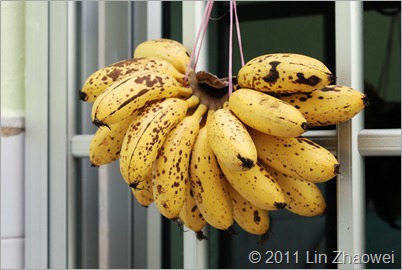
 
DSC_5652

Why are you hanging at my window, Mr Banana?


“You mean you don’t know? Hokkiens believe bananas bring good fortune. Gim jiou! Gim jiou! Kuai dian zhao, kuai dian zhao!” she replied enthusiastically. (My mum is Cantonese though)

Gim jiou is Hokkien for banana, which is read the same way as “bringing in gold”. The latter bit, in Mandarin, means to hurry up and bring in (the gold). There was something about the way my mother said it that made me and my sister burst out laughing, but I guess that explains why some Chinese in Singapore hang banana-themed ornaments in their cars and houses.

Hmmm maybe that’s part of the reason why I had a relatively good Year of the Tiger. Work-wise I had the chance to go to Pakistan and Japan for work assignments, and also got a chance to write my first opinion piece. And last month, I got promoted and collected my first proper bonus (along with the rest of the company, of course). As for my personal life, I met Joanne and so far had some wonderful times with her both here and on our overseas vacations (three so far, and much more to look forward to this year). To Joanne’s sisters: nope, I really didn’t have to sell my organs to pay for the trips so far. Haha.

You see, I’d bought a new watch last June as a birthday present to myself, from a shop in Ion shopping mall in Orchard Road:

 
DSC_5666

I call it my “banana watch”, and I wear it every time I go out. The design is apparently based on a famous banana painting done by the father of pop art.


From what I understand, the painting was featured on a legendary rock album by Velvet Underground, and that was probably part of the reason why it became so famous.

While I would have loved to get a Jaeger LeCoultre from a luxury watch shop, I figured it was not the right time yet and settled for something slightly cheaper. Actually I was attracted initially to another Andy Warhol watch at the same shop in Ion but settled on the simple but elegant design of the banana watch. I also like it that it’s quite thin and light, which makes it less uncomfortable to wear throughout the day. Get it here if you want! (Please don’t wear it when you meet me though, it’ll be awkward.)
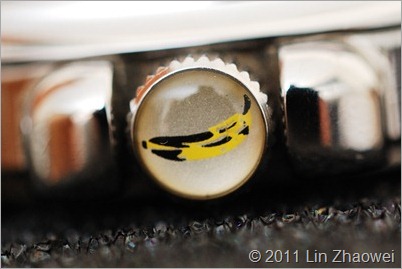
 
DSC_5681

Oh hey, there is a banana on the watch dial too!


Yes, yes, this is all superstitious nonsense, you may say. I’d be a fool to count on my watch for good luck too, but every little bit helps, I suppose? :)

**************************

PS: I’d discovered a good Hokkien online dictionary as I was confirming the Hokkien pun, since I know only a little of my dialect. For those who are keen to become Hokkien experts, click here.

Thursday, February 3, 2011

Happy Lunar New Year

To all my Chinese readers (I’m guessing there’re at least a couple), Happy Lunar New Year! I wish you and your loved ones all good health and prosperity in the year of the Rabbit. May you advance in the workplace or in your studies, and overcome all the troubles that may come your way. (And I hope you will continue reading my blog too, and let me know if you do!)

Actually I haven’t had the habit of making festive greetings on my blog, but a comment a friend made about Chinese New Year recently got me thinking, and I would like to share my thoughts here.


DSC_5613

My reunion dinner is taken at home with my family every year. We usually have steamboat, with a variety of simple but delicious items. Let me share with you what we have this year. Here, we have tofu, crabsticks and cocktail sausages.


Basically, my friend made the comment the other day on Facebook, saying that he felt embarrassed when he explained the various Chinese New Year greetings to his foreign friends. I was actually quite perplexed by that comment, and asked for some examples. I didn’t quite agree with what he said though!


DSC_5618

Chicken, pork and pork liver! Liver always look a little bloody, but I love the texture.


To the uninitiated, many CNY greetings revolve around wishing people good luck and prosperity. The most common 恭喜发财 (gong xi fa cai) means literally congratulations for getting rich. 心想事成,万事如意 (xin xiang shi cheng, wan shi ru yi) means to get what one wishes for; the often punned upon 年年有余 (nian nian you yu) means to have surpluses every year, with the pun on 鱼 (yu), or fish. 金玉满堂 (jin yu man tang) means to have a house full of gold and jade, which means a house of wealth. 福星高照 (fu xing gao zhao) means to have the god of fortune shine on you.


DSC_5630

Yummy and healthy greens and mushrooms. Golden mushrooms, or enoki, is probably my favourite mushroom for steamboats, as they absorb the soup and maintain their crunchiness.


Not all of the greetings directly has to do with luck and money, of course. For working adults who are more junior than us, we wish them 步步高升 (bu bu gao sheng), or to rise up step by step. We wish students 学业进步 (xue ye jin bu) or to advance in one’s studies.  Of course, if any one really wishes to advance in the workplace or in one’s studies, one has to put in hard work. But we wish that their efforts pay off.


DSC_5624

Fish and squid. So that we can have surpluses (余) – a pun on 鱼, or fish – every year.


As you can see, many of these greetings basically express goodwill towards others. We wish the best for others; they wish the same for us. While in Chinese we have a term for this – 礼尚往来 (li shang wang lai), which means to reciprocate courtesy – but I believe it’s very much a universal thing. During the CNY period, which is the most important celebration of the year, naturally we amplify the goodwill we express to others. Everyone wants a good year, and by wishing others the best, we ultimately also wish the best for ourselves.


DSC_5620

All balls: plain ones made of fish paste, those with mushroom bits added in, chicken balls, cuttlefish balls… Always a delight to have, they add colour and shapes to the steamboat concoction, and cook extremely quickly as well. Kids love them.


Well, that’s it from me. Many of our Chinese traditions are slowly dying out in modern society. And soon I can foresee that Western traditions and festivals will dominate, if they haven’t already. That is sad, because there is very little to define what a Singaporean is to begin with. The erosion of what makes the Chinese here Chinese, seems to be an erosion of part of what makes Singapore unique – our racial/ethnical fabric. There is some revival of interest in Chinese language and culture now, but that is purely driven by commercial interest in the economic juggernaut of China. But I shall not be too pessimistic.


DSC_5627

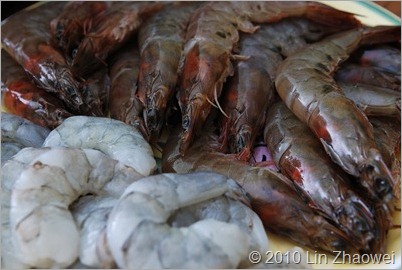
Steamboat is incomplete, however, without my favourite – prawns. Nothing like shelled prawns cooked in soup. This retains the natural sweetness and juiciness of the prawn – the way prawn should be enjoyed. (The de-shelled ones were prepared for my sis, who doesn’t like peeling them)


Actually I have a distaste for Western traditions because they are mostly heavily commercialised. Christmas,  Valentine’s Day, Thanks-giving, Halloween, etc… While they are interesting to celebrate they mean absolutely nothing to me. (No offense to Christians intended. I fully understand Christmas’ importance to you, you probably have to admit it is dominated by commercialism in many places these days.)

It’s also somewhat telling that most popular images of these traditions/festivals are about wild partying, getting drunk and shopping. I’ll take exchanging mandarin oranges and saying happy and fluffy things to family and loved ones any day.

**************************

On a separate note…

Lunar New Year has never truly had any special meaning for me. In fact, for the longest time my feelings towards it had been more negative.

It definitely has got to do with my family background. Because of my father’s irresponsible ways, we were more or less cut off from both sides of the extended family through my formative years. So instead of visiting relatives and family friends like most of my peers do, I usually just stayed at home throughout the two- or three-day holiday. Of course this wasn’t a problem in itself, but when I went back to school the following day, people would be talking about what they did during the holidays, how many red packets they had received and perhaps more critical to teenagers like I was then, how much was the haul for the year. (Coming from a top secondary school when most people came from well-to-do families, the sums naturally were quite significant.)

Things have changed since he died about 8 years ago. We have renewed contact with the extended family, and I do join my relatives for CNY gatherings these days. I guess that restores some “normality” to my CNY’s.

Now that I think about it, missing out on CNY in the past have probably contributed to my reclusive nature.

Saturday, January 29, 2011

Tanjong Pagar Railway Station (Part 2)

If you missed it, Part 1 can be found here.

As mentioned in the first part, this shoot was done entirely on film. As I went through the process of having to go to a photo lab to develop and scan the two rolls of film, I couldn’t help but lament the inconveniences of film. Yet there is something distinctively satisfying about shooting with film. Good thing I’ve decided to hang on to my F6, I guess.


10.12.20 - Tanjong Pagar Railway Station (41)

Workers on the tracks examining the Orient Express train.


10.12.20 - Tanjong Pagar Railway Station (42)

Seats for waiting passengers just outside the platform. You can see how aged they are.


10.12.20 - Tanjong Pagar Railway Station (43)

Some of the shops at the station. I peered into Quick Baggage and found that they are apparently still in operation. Not sure what they do though…


10.12.20 - Tanjong Pagar Railway Station (65)

A man drinking his morning teh in the station’s main hall. He turned away when he saw me approaching, unfortunately.


10.12.20 - Tanjong Pagar Railway Station (68)

Some graffiti on the station’s wall.


10.12.20 - Tanjong Pagar Railway Station (69)

There is a resting area with bunk beds inside the station. I’m not sure who stays here, but I’m guessing that the lodging is fairly cheap.


10.12.20 - Tanjong Pagar Railway Station (70)

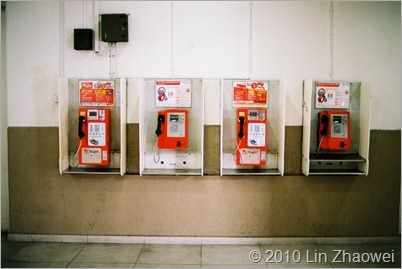
A row of pay phones in the station. Always a treat to see these in Singapore – so many people here own mobile phones that they are very rare to find these days.


10.12.20 - Tanjong Pagar Railway Station (72)

Not a great shot, but thought I should include a shot of the station’s exterior. This was the only time I wished I had a wider lens – namely my AIS 28m f2.8 – on me that morning. (I only had the 35mm that morning.)


After I got home that day, I went online to check out more information about the eateries at the station. I was just a little puzzled whether many Singaporeans visit the place for food. According to some blogs I came across, the satay there is supposedly quite good. But there are differing opinions on that, so I shall probably give it a miss.

Monday, January 24, 2011

Tanjong Pagar Railway Station (Part 1)

After the successful conclusion of talks between the Prime Ministers of Singapore and Malaysia last year, Tanjong Pagar Railway Station would cease operations this July. The new station, which will be the new terminus for trains coming from Malaysia, is to be located at Woodlands checkpoint.

I’d been wanting to visit the station for a long time, but never got down to it. In fact, the announcement of the breakthrough talks gave me fresh impetus to visit it, but it took me till December before I finally made my way down for a quick morning shoot.

This was also the first time I shot with my new Nikon AIS 35mm f1.4 lens, paired with the F6. As expected, manual focusing with the F6 was easy. The image quality was excellent too, judging from the scans. It could be my one-lens travel solution with the F6 (if I ever dare to venture with just a film camera in hand, that is). More reading material about the lens here.

10.12.20 - Tanjong Pagar Railway Station (02)

I sneaked onto the platform, not knowing that I was not allowed in. I actually walked all the way to the end (I think the platform is about 200m long) before a station master rode his bicycle down the platform and asked me to leave. I managed to get a concession from him though – to take this picture and the next.


10.12.20 - Tanjong Pagar Railway Station (04)

There were people inside the police post, and I think they saw me walk down the platform, but didn’t stop me. Haha. So much for security.


10.12.20 - Tanjong Pagar Railway Station (15)

Welcome to Singapura!

This is probably my favourite shot of the day. I’d actually wanted to take it from the inside, but as mentioned, I got chased out. I took it from the road that runs parallel to the platform. The blurry black marks are there because I shot through the fence.


10.12.20 - Tanjong Pagar Railway Station (17)

A lazy cat trying to sleep on the platform. In the background is the Orient Express, the luxury train that runs all the way to Bangkok. I hope to take it one day.


10.12.20 - Tanjong Pagar Railway Station (19)

One of the two coffeeshops located inside the station. I don’t know why there are two though. Both seemed to be filled with customers when I visited.


10.12.20 - Tanjong Pagar Railway Station (24)

A man buying a train ticket from the counter.


10.12.20 - Tanjong Pagar Railway Station (32)

Travellers dressed in spiffy suits and dresses enquiring about their Orient Express trip.


10.12.20 - Tanjong Pagar Railway Station (01)

The check-in sign at the station entrance. You don’t want the Orient Express customers to get lost! They paid good money for their ride.


Colour photos to come in the second part… ;)

Addendum: Part 2 can be found here.

Friday, December 10, 2010

Blazing 28 debut

I bought the Ricoh GXR 28mm f2.5 today. Finally! Ever since it was announced in March, I had been very curious about this lens. After I bought the GXR in September for my Pakistan trip, I was even more eager to try it out – while the 24-72mm zoom unit gave me a taste of the wonderful features of the GXR, from the many customisable settings to the advanced shooting options, I was never entirely convinced of its image quality at ISO 400 and above. (As a side note, I believe the pictures ST used for my Pakistan article were shot at ISO100 or 200)

I got to try out the 28mm unit when I visited Japan in October, at Ricoh’s Ringcube showroom in Ginza, Tokyo, and I was quite impressed. It was a pre-production model, however.

Last month, the lens was finally released in Japan, and two weeks later, it has arrived in Singapore. I was so excited to hear that my neighbourhood camera store (MS Color at Ang Mo Kio Hub) had it in stock, and I rushed down to the store after I attended a function Wednesday night. Alas, it turned out that I had used up the available funds in my current account because I’d spent a pretty penny on a pair of sunglasses earlier in the day, and I couldn’t pay up! So I paid a S$100 deposit and went there during my lunch time today and snapped it up.

When I slid the unit into my GXR and turned it on, I could immediately feel its tremendous quality. What has impressed me about the 28mm:

  1. Impressive ISO performance all the way to ISO 3200. Thanks to the large APS-C sized sensor. It easily trumps my 3-year-old Nikon D40X, even though the sensor size is the same.
  2. Very sharp lens. I was very impressed when I looked at the LCD of the Panasonic GF1 in Japan. With the 28mm on the GXR, I have nothing left to envy.
  3. Fast AF. Ok it wouldn’t be fair to compare to my Nikon lenses on this, but for a compact camera, the 28mm is very fast and responsive. Definitely good enough for most shooting conditions, except for action/sports.

What could have been better:

  1. An even faster lens, say f2? (I think f1.4 might be a bit too much to as for in a compact camera)
  2. 43mm filter size instead? Why on earth does the 24-72mm unit use a 43mm filter while the 50mm and 28mm use 40.5mm?
  3. A gold ring instead of a red one? Ok that’s just the Nikonian in me. Haha.

The lens was put to use on the very same day, as I attended a long-awaited gathering of my primary school class. It wasn’t exactly a snapfest, as 1) I was late and 2) I think I was better off trying to catch up with the rest. But I got a few good shots, and I think I can expect plenty more for the lens.

More to come!

R0014629

Eating dinner while everyone else was finishing dessert… Hehe.