Showing posts with label culture. Show all posts

Thursday, August 15, 2013

How Instagram has reinvigorated my photography

The main reason why most blogs die off is the lack of an audience. By that count, it's a wonder I've kept this blog going for so long... (albeit with rather infrequent updates)
Fortunately, I love photography enough to keep going!

Of course, even the deepest well will run dry some day, so I recently sought to find better ways of sharing my photography. I first tried porting this entire blog over to Tumblr because it has social network functionality built-in, and then discovered to my disappointment its lack of SEO. This blog completely trumps it, and I suspect Google's ownership of Blogger has to do with it too.


I considered making better use of Flickr, where I already have an account, but even with the recent upgraded interface and 1TB of storage, I feel reluctant to put too much energy into a platform that doesn't seem to be drawing in new users. It didn't help that their app isn't available in my region for my iPod Touch 5, my main media sharing and consumption device. (I use a Blackberry Z10 as my main communications device)

Then came Instagram. I was actually asked by my wife to set up an account so I can follow and "like" her photos on the service. I dutifully did so and ignored the platform for a while, until the start of July.
I can't remember why I started taking an interest in the first place, but since then I've been a very active member of the community. Initially, I didn't have any specific goal for the platform. I thought of it as an extension of my current photo sharing on Facebook, Blogger and Tumblr.
Actually, this isn't my first posting on Instagram. The real original has been cleared out because it was a random shot that doesn't quite merit the real estate!
But after I started exploring the platform further, I started to see its potential as my main platform for sharing photos. Firstly, it doesn't require me to write much. While I do enjoy writing, it is time-consuming and takes time away from the main purpose of my blog -- photography. Secondly, there is an active community on the platform who are engaged and always exploring new content. Thirdly, you do get a lot of feedback in the form of 'likes' and comments, though people are unlikely to give any criticism.

Monday, March 5, 2012

The Kyoto shrine I almost missed (again)

My first trip to Japan’s cultural capital was in the autumn of 2007. After a friend encouraged me to do more with my time in Japan, I packed my bags, took a week of absence from university exchange classes and headed off to Kyoto on a cheap night bus for my first major trip of my one-year stay.

My guide book then was a book about viewing cherry blossoms and autumn foliage in Kyoto, and it included several classic walking trails, including one to Kinkakuji (金閣寺) and Ryoanji (龍安寺), another to Kiyomizudera (清水寺), and others to less well-known destinations such as Kurama (鞍馬). I thoroughly enjoyed that trip, and on my second visit there in February 2008, I revisited many of the same places.

 
F1020011

Bathe me in luscious red and orange


So when I visited Kyoto again in February 2012 – this time with my family and my girlfriend – I’d planned to stick to my tried and tested itineraries. But my independent-minded sister insisted on going to the Fushimi-Inari Taisha (伏見稲荷大社). Who was she (someone who’d only been to Japan once) to tell me (with many trips within Japan under my belt) where to go?

Monday, January 16, 2012

My 2011 in pictures

2011 was certainly an eventful year, but I still can’t say for sure if I could call it a good year.

Work-wise, it was by far the toughest year since I started work. Had to deal with the disappointment and anguish of not getting the reports when I went to Japan to cover the March 11 disasters. Tougher though, was coping with the change to local news reporting, which has made work-life a little more colourful but infinitely more stressful. (I’m still debating if it was the right move)

 
11.05.07_08-WP-137

PICTURE OF THE YEAR: The Workers’ Party’s historic capture of a GRC at the May 7 General Election is easily one of the biggest events of the year, and I had the privilege of witnessing and capturing the electrifying atmosphere that night. The real bonus was submitting it to my paper’s photo desk and having it selected for our front-page the following day. It doesn’t get bigger than that for me.


On the other hand, I think little has changed in terms of my personal life. Still dating the same (wonderful) Joanne, still hanging out with the same friends. Went on two holidays – both of which were to places I have visited before (Hong Kong and Tohoku, Japan).

As with the previous couple of years, I guess the bright spots are the good photos I managed to take during the course of the year. The May 7 General Election was arguably the biggest event of the year in Singapore – not just because of the result but also the socio-political changes it brought on, and I was glad I used my time off work to visit the various rallies, as well as the results announcement at Serangoon Stadium.

Tuesday, October 25, 2011

Sendai Tanabata (2): Outdoor shows

While the highlight of the Tanabata is definitely the long, flowing Fukinagashi streamers around town that I mentioned here, the festival has in recent times expanded to include outdoor events as well.

There are free musical and cultural performances by groups from Sendai and other parts of Japan, as well as the usual food and games stalls lining the sidewalks, turning the city into one big carnival.

At Kotodai Park, the main venue, you can catch live performances by local music artistes and school groups. There was also a segment where they showcased the Suzume-odori (すずめ踊り, meaning “Sparrow dance”), a part of the annual Aoba Matsuri (青葉まつり), a spring festival. The festival was not held this year because of the March 11 disasters.

 
FH000003

A bunch of friendly youngsters at Kotodai Park (勾当台公園), the main venue for the outdoor performances during the Tanabata.


All photos taken with the Nikon F6, with the AFS 24mm f1.4 or AIS 35mm f1.4. I used Kodak Portra 800 and Fujifilm Superia  Premium 400 films.

Monday, October 17, 2011

Sendai’s Tanabata(1): At the Shopping Arcade

Ah, Sendai.

I was there just five months ago, immediately after the March 11 triple disasters. I’ve been wanting to go there since I was in Japan for my university exchange in 2007/2008, but haven’t been able to fit it in. And when I finally got there in March (and the journey took a whole day on the road), it was hardly the kind of circumstance I was expecting.

But by August, there were little signs of what happened less than half a year ago. As I stepped out of JR Sendai train station for the first time, I was greated by giant fukinagashi streamers, the iconic Tanabata ornament. I knew I was there to celebrate this time.

 
FH000034

Thousands of streamers can be found around Sendai city’s central area during the annual Tanabata festival.


The Tanabata festival (七夕) actually originated from the Chinese Qi Qiao festival, and celebrates the yearly union of the deities Orihime and Hikoboshi.

And while Tanabata is celebrated all over Japan and not unique to the city, the scale of Sendai's Tanabata is by far the largest in the country, drawing about 2.2 million visitors each year. The tradition of celebrating Tanabata in Tohoku started more than 400 years ago, with records found from the time of Date Masamune (1567-1636AD), warlord of the Sendai Clan.

Wednesday, September 28, 2011

Akita’s Kanto Matsuri

The second stop of my summer matsuri vacation was the city of Akita, known for its delicious rice, beautiful women, and the Akita Inu dog breed. (Hachiko, the legendary canine who waited for its dead master at Shibuya train station for a decade, was an Akita Inu.)

Akita’s Kanto Matsuri (竿灯まつり), which draws 1.3 million visitors annually, involves adult men balancing huge bamboo frames – called kanto – through various means during an evening parade. The most basic move is balancing the pole on the palm, but the more skillful performers would try doing so on their shoulders, their heads, or even their hips.

Historical records show that the Kanto festival started at least 250 years ago, its main purpose to pray for a good rice harvest. The practice of balancing the kanto was said to have started as a means to stave off the lethargy caused by the summer heat.

 
FH040013

One of the many groups at the Kanto festival. The biggest kanto are 12m high and weigh 50kg, with about 46 paper lanterns attached.


Shooting this festival was a major challenge for me. Firstly, framing was difficult because the performers are constantly on the move. Secondly, it’s difficult to capture the right background because everyone else is also moving. Thirdly, as the people with the kanto do their balancing act, their team members move around them, often preventing me from getting a clear shot. Lastly, there generally isn’t much variation – the moves don’t differ that much after a while…

Sunday, September 11, 2011

Aomori Nebuta 2011 (3): I’ll be back!

Although staying four nights in Hirosaki seemed like a long time for a small city, it turned out to be too short a stay. We’d spent one evening at the Hirosaki Neputa, two at the Aomori Nebuta, and one at the Goshogawara fireworks festival.

While the fireworks were dazzling and the Neputa an interesting variation of a float parade, the Nebuta had arguably the most to offer, and regrettably we missed the grand finale, on August 7.

Besides the evening parades from August 2 to 6, the last day of the matsuri is quite different – there is a parade featuring the floats in the day, and in the evening, the floats will parade on the waters of Aomori Bay, against the backdrop of a fireworks display. I was gutted that I couldn’t be there. (By then, we had to be in Sendai, our final stop)

And as a prelude to the Nebuta, there is also a fireworks event at Asamushi Onsen (浅虫温泉), a hot springs town just about 30-45 minutes away from Aomori City. Just imagine soaking in an outdoor onsen while viewing fireworks!

Anyway here are some more pictures taken at the Nebuta. Once again, all on Kodak Portra 800 film, Nikon F6 with the AIS 35mm f1.4 lens and SB900 flash.

 
44980014

“We’re going to the matsuri!”


Wednesday, September 7, 2011

Aomori Nebuta 2011 (2): After the clock strikes 7.10pm…

The main draw of the Nebuta Matsuri is the nightly two-hour parade. Each participating group usually consists of a float accompanied by haneto dancers chanting "Rase-rase-rasera!" and moving in unison to the beat of a marching band.

Each float, which is pushed manually and lit up from within, may measure up to 5m high, 9m long and 7m wide, and weigh up to four tonnes. Costing up to 4 million yen each to build, they usually depict scenes from Japanese and Chinese mythology.

As the sun begins to set, the performers line up on the four major roads closed off for the parade. The roads form a ring, and within the two hours, the performers will cover all four roads and get back to where they started. The audience members, lining both sides of the roads, wait in anticipation as they guzzle their beer and lap up their take-away sushi.

Once the clock strikes 7.10pm (don’t ask me why), the procession begins!

The photos were taken on August 2 and 4. I used my Nikon F6 paired with the Nikkor AIS 35mm f1.4 or AFS 24mm f1.4, on Kodak Portra 800 film.

 
44960005

RASE RASE RASERA! RASERAAA! RASERAAA!


Monday, September 5, 2011

Aomori Nebuta 2011 (1): People watching

It was my trip to Aomori last year that first piqued my interest in returning to the prefecture again, for its most famous celebration of the year. So perhaps it was most befitting that I started my jaunt through the Tohoku Sandai Matsuri (東北三大祭り), or Tohoku’s three big festivals, with Aomori's Nebuta Matsuri (ねぶた祭り).

It is also the earliest of the three famous festivals to start (Aug 2), and stretches all the way till Aug 7. This makes it the longest of the three.

While the exact origin of the Nebuta Matsuri is unclear, some historical records say a variation of it had already taken place in the Kyoho era (1716 to 1735) of the Tokugawa period. It was much simpler then, however, and involved a parade of people carrying lanterns.

The festival now is far more elaborate now, and attracts over 3 million visitors a year from all over Japan and overseas. Here’s a look at some of the people who were there on Aug 4, 2011.

 
44970009

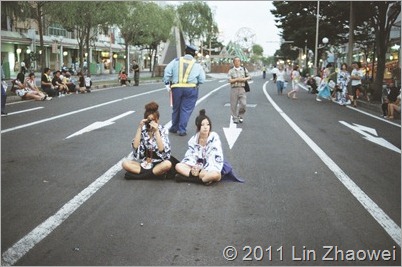
With the roads closed off for the festival, you’re free to sit anywhere! These girls are dressed in the haneto costume, which is worn by performers as well as those who wish to join in the parade.


Wednesday, February 9, 2011

Gone Bananas

Yes, because I took two days of medical leave for the first time since I started working in June 2009.

Ok, but that’s not the point of the post. Falling sick (viral cough,  doctor says) gave me some time to write this post as I’m supposed to stay home and rest.

In keeping with the festive theme of the previous post, I’m talking about bananas and good fortune for the Chinese. Singaporean Chinese, at least, because I do not know if the same applies to other Hokkien-speaking Chinese elsewhere in the world, such as those in China’s Fujian province or in Taiwan.

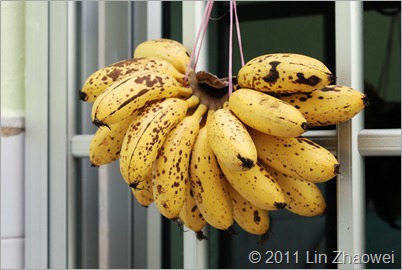
Anyway, my mother bought a bunch of small bananas and hung them at our kitchen window for Chinese New Year. That’s uncharacteristic because our family prefer eat only the bigger varieties such as those from Del Monte, so I asked her why she bought them...

 
DSC_5652

Why are you hanging at my window, Mr Banana?


“You mean you don’t know? Hokkiens believe bananas bring good fortune. Gim jiou! Gim jiou! Kuai dian zhao, kuai dian zhao!” she replied enthusiastically. (My mum is Cantonese though)

Gim jiou is Hokkien for banana, which is read the same way as “bringing in gold”. The latter bit, in Mandarin, means to hurry up and bring in (the gold). There was something about the way my mother said it that made me and my sister burst out laughing, but I guess that explains why some Chinese in Singapore hang banana-themed ornaments in their cars and houses.

Hmmm maybe that’s part of the reason why I had a relatively good Year of the Tiger. Work-wise I had the chance to go to Pakistan and Japan for work assignments, and also got a chance to write my first opinion piece. And last month, I got promoted and collected my first proper bonus (along with the rest of the company, of course). As for my personal life, I met Joanne and so far had some wonderful times with her both here and on our overseas vacations (three so far, and much more to look forward to this year). To Joanne’s sisters: nope, I really didn’t have to sell my organs to pay for the trips so far. Haha.

You see, I’d bought a new watch last June as a birthday present to myself, from a shop in Ion shopping mall in Orchard Road:

 
DSC_5666

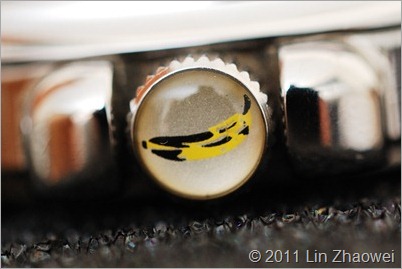
I call it my “banana watch”, and I wear it every time I go out. The design is apparently based on a famous banana painting done by the father of pop art.


From what I understand, the painting was featured on a legendary rock album by Velvet Underground, and that was probably part of the reason why it became so famous.

While I would have loved to get a Jaeger LeCoultre from a luxury watch shop, I figured it was not the right time yet and settled for something slightly cheaper. Actually I was attracted initially to another Andy Warhol watch at the same shop in Ion but settled on the simple but elegant design of the banana watch. I also like it that it’s quite thin and light, which makes it less uncomfortable to wear throughout the day. Get it here if you want! (Please don’t wear it when you meet me though, it’ll be awkward.)

 
DSC_5681

Oh hey, there is a banana on the watch dial too!


Yes, yes, this is all superstitious nonsense, you may say. I’d be a fool to count on my watch for good luck too, but every little bit helps, I suppose? :)

**************************

PS: I’d discovered a good Hokkien online dictionary as I was confirming the Hokkien pun, since I know only a little of my dialect. For those who are keen to become Hokkien experts, click here.