Showing posts with label journalistic. Show all posts

Thursday, August 15, 2013

How Instagram has reinvigorated my photography

The main reason why most blogs die off is the lack of an audience. By that count, it's a wonder I've kept this blog going for so long... (albeit with rather infrequent updates)
Fortunately, I love photography enough to keep going!

Of course, even the deepest well will run dry some day, so I recently sought to find better ways of sharing my photography. I first tried porting this entire blog over to Tumblr because it has social network functionality built-in, and then discovered to my disappointment its lack of SEO. This blog completely trumps it, and I suspect Google's ownership of Blogger has to do with it too.


I considered making better use of Flickr, where I already have an account, but even with the recent upgraded interface and 1TB of storage, I feel reluctant to put too much energy into a platform that doesn't seem to be drawing in new users. It didn't help that their app isn't available in my region for my iPod Touch 5, my main media sharing and consumption device. (I use a Blackberry Z10 as my main communications device)

Then came Instagram. I was actually asked by my wife to set up an account so I can follow and "like" her photos on the service. I dutifully did so and ignored the platform for a while, until the start of July.
I can't remember why I started taking an interest in the first place, but since then I've been a very active member of the community. Initially, I didn't have any specific goal for the platform. I thought of it as an extension of my current photo sharing on Facebook, Blogger and Tumblr.
Actually, this isn't my first posting on Instagram. The real original has been cleared out because it was a random shot that doesn't quite merit the real estate!
But after I started exploring the platform further, I started to see its potential as my main platform for sharing photos. Firstly, it doesn't require me to write much. While I do enjoy writing, it is time-consuming and takes time away from the main purpose of my blog -- photography. Secondly, there is an active community on the platform who are engaged and always exploring new content. Thirdly, you do get a lot of feedback in the form of 'likes' and comments, though people are unlikely to give any criticism.

Friday, March 8, 2013

Rock Bar at Ayana Resort, Bali

 
DSCF1914a

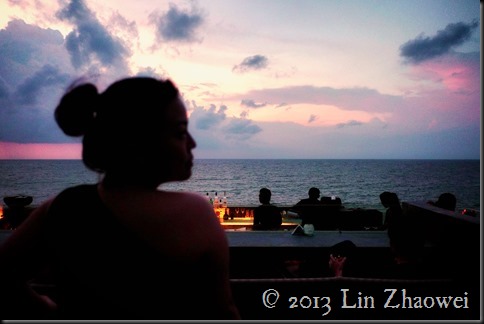
THE NIGHT IS STILL YOUNG: Partying till the sun goes down at Ayana Resort’s Rock Bar, which as the name suggests, rests on rocks jutting out into the sea. A wonderful place to enjoy an apertif and see the sunset before retreating to one of the resort restaurants for a sumptuous dinner.


DSCF1890a
 
 
DSCF1908a
 

Love this place, I really have to go back again soon.

Tuesday, November 27, 2012

A reminder to exercise more

Was hanging around Marina Bay Sands mall while waiting for a late evening appointment last weekend, and decided to sit outside the mall at the promenade facing the bay, where it’s quiet and breezy.

I’d just found my spot and started reading a book I’d just bought from Kinokuniya when a woman cycled through and shouted to people walking about, “Please move to the side! Please move to the side!” I was wondering what the fuss was about, until a couple of people wearing number tags ran past me. I thought, nah, just a few runners, and continued sitting there and reading my book.

About five minutes later, more and more runners ran past me. I started getting a little comfortable. It was impossible to read with sweating people running past you every few seconds. Then the runners started turning up in packs. I knew it was time to move.

Trying to make the best of the situation, I decided to take out my camera and take some shots of the runners. Admittedly, the route they were running on was very poorly lit – I’m not sure how the organisers got away with that – which made it impossible to shoot on anything lower than ISO 6400. But the X-Pro 1 has great ISO performance, and coupled with the bright lights from the mall and hotel blocks, I managed to snap a few shots.

 
DSCF1432a

EVENING JOG: The buggers who disturbed my peace. Well at least they made me get up and take some photos. I later found out that it was called Run Happy Singapore 2012, a rather peculiar turn of phrase. Never understood why anyone would pay to run on public property though.


Which reminds me, it has been 5 years since I went for a long run. I took part in the Army Half-marathon in 2007, which I’d taken months to prepare for. It was quite a unique (and may I add, healthy) experience. My friends and I didn’t sign up though – we just joined in as unregistered participants. As I mentioned above, I always thought it was silly to pay to take part in a run. Unless of course, the money goes to a charitable cause.

These days, I find it hard to even go for a short jog. I really should start doing so…

Friday, July 27, 2012

Singapore’s new concrete jungle

Like many other Singaporeans, I lament the lack of interesting places to go on my days off work. But with the opening of the Bay South Gardens last month, there is a new place to check out.

As with any new national attraction, the park was flooded with visitors in the first days after its opening. Naturally, I avoided the place the first couple of weeks. But earlier this week, a couple of university friends wanted to meet there for dinner. As I finished work early, I went down two hours ahead of time for a little walk (in spite of the heat and humidity).

 
R0031920

A BREATH OF FRESH AIR: A jogger at the Gardens, with the Supertree Grove in the background. Seen in the distant background are the Marina Bay Sands and Singapore Flyer.


Monday, April 9, 2012

Labrador Park

I visit parks less often than I would like to, but some time last month, I decided to brave the heat and humidity for the first time in a while to get away from the usual mall crawling.

This time, I chose to go to Labrador Park, which is now easily accessible via its very own MRT station on the Circle Line. I had gone for a little gathering at a colleague’s place just a stone’s throw away a couple of weeks before, so somehow it was the natural choice for this outing.

The weather was quite hot that evening, but at least there was a slight breeze to moderate the heat. Not many people were at the park even though it was the weekend, thankfully, which made the walk quite a pleasant one.

 
F1000020a

I’M GONNA GET YOU: An angler casting his line into the sea as the sun sets. (Admittedly, the sunset colours don’t quite come out in black and white photography.)


Photos taken with the Nikon F6 and Kodak T-max 400 film, using the Nikkor AIS 24mm f2 and Carl Zeiss 100mm f2 ZF lenses.

Monday, March 5, 2012

The Kyoto shrine I almost missed (again)

My first trip to Japan’s cultural capital was in the autumn of 2007. After a friend encouraged me to do more with my time in Japan, I packed my bags, took a week of absence from university exchange classes and headed off to Kyoto on a cheap night bus for my first major trip of my one-year stay.

My guide book then was a book about viewing cherry blossoms and autumn foliage in Kyoto, and it included several classic walking trails, including one to Kinkakuji (金閣寺) and Ryoanji (龍安寺), another to Kiyomizudera (清水寺), and others to less well-known destinations such as Kurama (鞍馬). I thoroughly enjoyed that trip, and on my second visit there in February 2008, I revisited many of the same places.

 
F1020011

Bathe me in luscious red and orange


So when I visited Kyoto again in February 2012 – this time with my family and my girlfriend – I’d planned to stick to my tried and tested itineraries. But my independent-minded sister insisted on going to the Fushimi-Inari Taisha (伏見稲荷大社). Who was she (someone who’d only been to Japan once) to tell me (with many trips within Japan under my belt) where to go?

Monday, February 20, 2012

Why are Japanese kids so cute?

Case in point:

 
F1030012

Elmo and brother, spotted near the exit of Kyoto’s Kinkakuji temple


And this:

 
F1030011

This was taken before the previous picture…


And the secret to them smiling and posing for the camera was this:

 
F1030013

The lady on the left is their very friendly and obliging mother, who was waving a lollipop so her children would look in the right direction!


Some people suggested that it’s what they wear, but I think it’s something more than that. An eternal mystery to me… perhaps until they start climbing over my head and break the spell…

(Photos taken on Nikon F6 with the Nikkor AI-S 35mm f1.4, on Provia 400X slide film)

Monday, January 16, 2012

My 2011 in pictures

2011 was certainly an eventful year, but I still can’t say for sure if I could call it a good year.

Work-wise, it was by far the toughest year since I started work. Had to deal with the disappointment and anguish of not getting the reports when I went to Japan to cover the March 11 disasters. Tougher though, was coping with the change to local news reporting, which has made work-life a little more colourful but infinitely more stressful. (I’m still debating if it was the right move)

 
11.05.07_08-WP-137

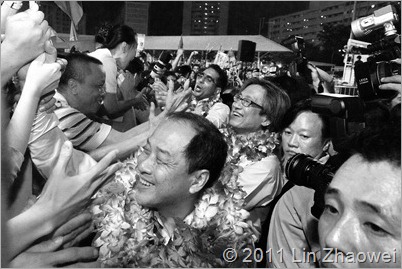
PICTURE OF THE YEAR: The Workers’ Party’s historic capture of a GRC at the May 7 General Election is easily one of the biggest events of the year, and I had the privilege of witnessing and capturing the electrifying atmosphere that night. The real bonus was submitting it to my paper’s photo desk and having it selected for our front-page the following day. It doesn’t get bigger than that for me.


On the other hand, I think little has changed in terms of my personal life. Still dating the same (wonderful) Joanne, still hanging out with the same friends. Went on two holidays – both of which were to places I have visited before (Hong Kong and Tohoku, Japan).

As with the previous couple of years, I guess the bright spots are the good photos I managed to take during the course of the year. The May 7 General Election was arguably the biggest event of the year in Singapore – not just because of the result but also the socio-political changes it brought on, and I was glad I used my time off work to visit the various rallies, as well as the results announcement at Serangoon Stadium.

Monday, November 14, 2011

Sendai City Office, revisited

When I was there in March, the Sendai City Office was a shelter for those who had lost their homes, or could not return to their homes following the tsunami and earthquake. (I wrote a litte about it here.)

When I revisited the office in August as part of my stopover in Sendai for the Tanabata festival (posts here and here), it had already been reverted to its original purpose. But the ground floor had been converted into an exhibition area of sorts, with pictures, posters and messages of encouragement from all over Japan.

 
FH000023

An old man looking at pictures of various recovery efforts in Miyagi prefecture.


Monday, September 5, 2011

Aomori Nebuta 2011 (1): People watching

It was my trip to Aomori last year that first piqued my interest in returning to the prefecture again, for its most famous celebration of the year. So perhaps it was most befitting that I started my jaunt through the Tohoku Sandai Matsuri (東北三大祭り), or Tohoku’s three big festivals, with Aomori's Nebuta Matsuri (ねぶた祭り).

It is also the earliest of the three famous festivals to start (Aug 2), and stretches all the way till Aug 7. This makes it the longest of the three.

While the exact origin of the Nebuta Matsuri is unclear, some historical records say a variation of it had already taken place in the Kyoho era (1716 to 1735) of the Tokugawa period. It was much simpler then, however, and involved a parade of people carrying lanterns.

The festival now is far more elaborate now, and attracts over 3 million visitors a year from all over Japan and overseas. Here’s a look at some of the people who were there on Aug 4, 2011.

 
44970009

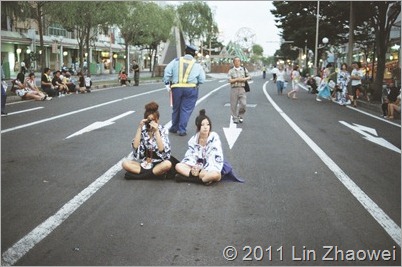
With the roads closed off for the festival, you’re free to sit anywhere! These girls are dressed in the haneto costume, which is worn by performers as well as those who wish to join in the parade.


Sunday, August 14, 2011

Hirosaki’s Neputa Matsuri

Because I decided on my trip just over a month before the summer festivals, I ended up staying at Hirosaki (弘前) town, even though my main purpose was to attend the Aomori Nebuta Matsuri (青森ねぶた祭り).  All the Aomori hotel rooms on Rakuten Travel were fully booked by the time I checked!

Well in any case, since we were in Hirosaki, I thought I might as well visit the local Neputa matsuri (ねぷた祭り), which started on Aug 1, the day we arrived there.

While it was of a much smaller scale than its neighbouring town’s event, I was very happy to have been a part of the Neputa because it was 1) a good chance to test the exposure settings for my F6 (important as film is so expensive!) and 2) to see how a float-based matsuri like the Nebuta flows.

 
44930002

Local youths running on the street with their float. As part of their manoeuvres, some of the carriers would raise up their floats, run towards the audience, and stop just in the nick of time, a step or two in front of the seated audience. This I believe to show their strength in manoeuvring their heavy loads. (Nikon F6 with AFS 24/1.4, Fujifilm Natura 1600 film)


Tuesday, July 19, 2011

What do you want to be when you grow up?

Something a little different for a change – I’m writing about the police and kids.

Have you seen the latest Singapore Police Force commercials? I happened to see one of them on TV the other day, and Joanne pointed out that she and her female colleagues recently crowded around one computer swooning over this particular one for ten minutes:

For more, you can go to the Singapore Police Force Facebook page or their YouTube channel  for the rest of the 2011 recruitment drive vids.

Coincidentally, I was actually planning to write a post about something I’d spotted a month ago during my visit to the National Museum, and it’s related to the police as well.

There was this activity corner on the second storey, where kids were invited to draw out their personal hopes and vision for Singapore, and put it up as part of an interactive exhibition. And one common thread I found was that many of kids wanted to be policemen and women when they grow up!

 
DSC_8626
 

Friday, July 1, 2011

Farewell, Tanjong Pagar Railway Station

The last train rolled into Tanjong Pagar Railway Station last night  (June 30). Hundreds of people crowded the historic building yesterday, for their last chance to see trains arriving at the tracks. If we count the many others who have streamed in over the past month, the figure would probably be closer to thousands, or even tens of thousands.

Although I was on afternoon duty yesterday, I’d toyed with the idea of heading out to the King Albert Park area to grab some shots of the 8am train headed for Johor. However, I had worked the late shift the night before, and stayed up till late to finish up the previous blog post. I decided that I would be too tired to work if I went. As it turned out, it rained cats and dogs in the morning, and I would have been drenched from head to toe, and dead like zombie at the office if I had gone.

Anyway, here’s the best of the other photos I took during my visit there earlier this week. All photos on Kodak Portra 160VC, taken with the Nikon F6 and AFS 24mm f1.4.

 
11.06.27 - Train to Johor (104)

A train driver on the walkie talkie as the train pulls out of Tanjong Pagar Railway Station.


Thursday, June 30, 2011

A photo guide to taking a train from Tanjong Pagar Railway Station

How time flies. I visited the Tanjong Pagar Railway Station about half a year ago to take some photographs, and before I knew it, the day when a KTM train leaves the station for the last time – June 30, 2011 – is almost here.

Joanne and I had been planning to take the train from the station for just one time, before the chance is over, but in typical fashion we procrastinated for a bit. It was June 26 when it finally struck me – there was less than a week to go. By then, Joanne had left for a holiday to New York, so I would have to go alone, I thought. But my mother, who last took the train more than 20 years ago, wanted to join me (perhaps driven by the hype in the media?). As it happened, I was off duty the following day – Jul 27 (Monday). We were set.

 
11.06.27 - Train to Johor (78)

One of the train station workers preparing for departure on June 27. The train was bound for Kuala Lumpur. I took the train to Johor Sentral Station, the first stop in Malaysia, and then returned by the next earliest train.


This month, Singaporeans have flocked to the station in droves to take photographs, enjoy the food at the two canteens and take a ride from there for the last time. The tickets for the last day, if I didn’t hear wrongly, were sold out weeks in advance. KTM must have made quite a killing in recent days, I suspect!

Since the train station closes today, I thought it might be interesting to show how the experience of taking a train from there is like, using some of the shots I have taken. Especially for those who have never done it before. Here goes!

Thursday, June 16, 2011

The park in my backyard

Some of you might have read about Ang Mo Kio Town West Garden park in the news recently – a 64-year-old man was allegedly killed by a teenager who was under the influence of drugs. Subsequent news reports highlighted that teenagers, sometimes in their school uniforms, are occasionally seen glue-sniffing in the bushes there.

Well, I happen to live close by, but I'm ashamed to say that I rarely pass by and have never seen the plastic bags used by the sniffers littered on the grass there. Not that I want to see them though.

 
11.04.07-07

A loving elderly couple taking a stroll in the park on a sunny Thursday morning in the Ang Mo Kio Town West Garden park.


I did actually go for a morning walk there in April, in a bid to finish using up a roll of film. There weren’t a lot of people around, but just enough activity to keep me snapping the 13 frames I had to expend.

Friday, June 10, 2011

It starts with a mini project at Serangoon

Two weeks ago, I attended a four-day course on “Visual Journalism”. I had been looking forward to this course, because I have always been interested in visual design.

And I came away inspired to do more photographic work.

The course, which revolved around the effective use of photographs and graphics in print design, was conducted by Mr Peter Ong, a former journalist who now runs his own consultancy. He is a guru at newspaper and magazine design, and has worked with publications all over the world, including in China, India and South Africa. He writes a blog about media trends and his work here. 

 
DSC_8296

A “No Peddling” sign at the old Serangoon Bus Interchange. Until I visited the place that day, I don’t think I had seen such a sign in Singapore! In a way I think it shows the age of the place.


On the last day of the course, we were assigned in groups of 4 to 5 people to do a simple report, with the use of graphics and photos. We had the whole morning to do it. My group was given the task of doing a photo essay on something around Serangoon Central.

Saturday, May 14, 2011

May 7 – A Historic Day for Singapore

Singapore’s General Election 2011 would go down in the history of the country as the first election where an opposition party won a Group Representation Constituency (GRC) since the scheme began in 1988. As a result, the opposition won six Parliamentary seats – the highest number since independence in 1965. (The previous high was four.) Also, it was the first time the opposition had contested so many seats – all but five of the total – to begin with.

 
11.05.07_08-WP-139

Workers’ Party leader Low Thia Khiang (middle) and his fellow Aljunied GRC MP-elects Chen Show Mao (bespectacled man behind him) and Pritam Singh (to Chen’s right) shaking hands with delirious supporters at Hougang stadium in the early hours of May 8, 2011, after their historic win in the 2011 General Election. (The colour version of this picture appeared on page 1 of The Straits Time’s special noon edition on May 8!)


GRCs are a unique system whereby Members of Parliament are elected in teams of three to six. The main reason behind this system, said the government, was to ensure minority representation in Parliament, because each GRC must include one MP from a minority race. There were 15 GRCs and 12 single seats up for grabs in the 2011 election, for a total of 87 places. 

The Workers’ Party (WP) had staged a strong challenge to the long-ruling People’s Action Party (PAP) in Aljunied GRC in the 2006 election, winning over 40 per cent of votes. The PAP’s Aljunied team, led by Foreign Minister George Yeo, fared the worse in terms of vote share among all winning PAP teams and single candidates.

This year, the WP threw in all its best candidates in the Aljunied GRC team, with Secretary-General Low Thia Khiang leaving his longtime stronghold, Hougang constituency, to his protégé Yaw Shin Leong, and personally leading the charge in Aljunied. Their ranks were further boosted by top corporate lawyer Chen Show Mao, who advised the Agricultural Bank of China on its world-record US$22 billion IPO last August. WP Chairman Sylvia Lim, postgraduate law student Pritam Singh and freelance counsellor Muhamad Faisal Abdul Manap made up the rest of the five-man ‘A’ team.

Tuesday, April 26, 2011

The Japan Quake (5): The turning point, Ibaraki, and the end

March 14. Our first and last day in Sendai. As mentioned in the previous post, we visited a few places near Sendai city, and caught a glimpse of the devastation. But it was evening before we knew it and it was time to head back to the city centre.

Just outside the City Office, however, we spotted a makeshift stall on the pavement selling miso soup and onigiri (rice balls). Instinctively, we quickly parked the van nearby, and queued up for our first warm meal for a day. They charged just 300 yen for a bowl of soup with two onigiri – quite a bargain in my opinion, given the scale of the disaster just tens of kilometres away. The miso soup was so gratifying that I had a second helping. The onigiri could be kept in my pocket for later, after all.

Then came the time to make the key decision of the trip.

Our drivers had been recalled by their bosses because of radiation fears. An explosion happened at the Fukushima No. 1 nuclear plant that afternoon, and it was the third in as many days. We tried to offer them more money, but they insisted this was not a matter of money – we could either go with them, or stay in Sendai and find our own way about.

I would be lying if I said I was fearless of the radiation threat. The possibility of over exposure to radiation was real, and undetectable. The night before I left for Japan, I monitored the news until about 1am in the office, and the last I read, the nuclear situation was fully under control. The next day (March 12), after I landed in Tokyo, I heard news of the first explosion. Then came the next two. Tepco, the company that runs the plant, did not seem to be in control of the situation at all.

But at the same time, we didn’t have anything substantial to show for the trip so far.

In the end, we decided – as a team – to go back to Tokyo.

It was past 2am, March 15 by the time we got to a hotel that had rooms. A quick trip to the convenience store to get some food and water. Never been so glad to enter one, really. Till that day, visiting a convenience store (or Combini) in Japan, to me, was an essential experience, a daily habit for any resident or traveller to this wonderful country. But this time, it was like a step back into sanity, back into a reality I was used to.

Back at the hotel, I took a shower for the first time in three days. Then I spent a couple of hours reading up NHK and other Japanese news sites on the situation in Ibaraki prefecture – the only tsunami-struck prefecture we could go to on a day-trip from Tokyo. I had to make the Ibaraki trip worthwhile, and research was essential. Afraid that I could not wake up in time, I left the lights and TV on.

A couple of hours later, I was up. Ate some bread, and headed downstairs. Our driver was supposed to come at 9am, and he was a little late.

Our first stop was the petrol station. Given the widespread petrol shortages, we were only allowed to buy 2,000 yen’s worth of fuel. But our driver Guo was quick-thinking – when the attendant walked away, he topped up the van’s tank to the maximum, paid up through the machine and quickly drove off. I wasn’t sure how much fuel we actually needed for the day’s drive, but having a full tank was most assuring.

The highway was packed bumper-to-bumper, and after a 30min crawl we realised the reason – they had sealed off the way to Ibaraki for exclusive use by relief vehicles. Guo once again showed some quick-thinking and somehow convinced the officers manning the road block to let us through. I filled up some forms at a table set up on the empty highway, and we received a plate to display at our windscreen, that read 緊急, or emergency.

The trip had up till this point been quite a surreal experience for me, but the journey on the near-empty highway was perhaps the most surreal portion. While I was still gungho about the trip just the day before, my fear of the radiation had escalated to almost hysteria at that point of time. The empty road seemed to suggest we were heading to some sort of suicide mission. Only the banter among the four of us journos kept my tears back, I think. Looking back, the fear was irrational, but what would you feel if you were in my shoes?

Here’s a short clip I shot of the drive:

Our destination was Oarai (大洗), a coastal town near the prefecture capital Miho (水戸). Ibaraki, located more than 100km away from the epicentre, was spared the worst of the tsunami, but there were around 20 deaths. One person died in Oarai. Another city, further north, had over 10 fatalities but I was not confident of getting there given the time we had.

We stopped at a highway kiosk along the way, and I spoke to the people working there. They were indeed afraid of the radiation, but they admitted there was no where they could go anyway. Most of them live nearby.

We arrived at Oarai after 2pm. It was practically a ghost town. I had a lengthy chat with a friendly youth who cycled past me. He is a university student who was visiting his friends around town. He told me of how the 1999 Tokaimura nuclear incident affected him as a primary school kid. (The Tokai plant is about 20km away) The situation in Fukushima, which has invoked memories of that episode, was causing the Oarai residents much anxiety despite assurances from the government that they were too far away from Fukushima to be affected.

This was when I got a call from my boss. The editors have decided to pull us back. Immense relief. But our work was not done yet. We did more interviews at the town, talking to town officials, residents and volunteers. Soon it was dark, and the town folk had left for home. It was about 5pm, and we had to head back to Tokyo. It was well past 8pm by the time we got back to our hotel. We bid farewell to Guo – he was leaving for the safety of Osaka in western Japan with his girlfriend and colleagues that same evening.

The following evening, we flew back to Singapore. I was pleasantly surprised to meet a friend from SMU at Narita airport – she now works for the Ministry of Foreign Affairs and they had flown in to help stranded Singaporeans at the airport. I touched down at Changi at about 1am, March 17.

On hindsight, I would forever question my decision to turn back to Tokyo from Sendai. Because we effectively gave up any chance of landing the stories we were there to get. Such is the cruelty of life. You make a decision and live with whatever regrets it leads to.

It’s been a month since the trip, and my disappointment has somewhat waned. But the question will linger in my mind for a while yet. I will have to make amends to myself, somehow.

 
R0015543

Carrots, shoes and cans on the dusty roadside.


R0015546

A soba shop, now littered with junk.


R0015552

Some workers helping to tow out a damaged vehicle from a garage. While the damaged from the tsunami was not too drastic in Oarai, the loss of property was still immense.


R0015564

Taken in my hotel room. Experts appeared on TV every day, giving their own take on the nuclear crisis and relief efforts. All the TV channels devoted their programming to the triple disasters during the time I was in Japan.


R0015568

At our hotel, but the room service staff would put paper cranes on our beds. It reminded me of the story of Sadako and her 1,000 cranes. May Japan emerge from this current nuclear disaster stronger than ever.


Part 1: It begun at Narita

Part 2: The long ride to Sendai

Part 3: Quiet night in Sendai

Part 4: A glimpse of the devastation

Wednesday, April 13, 2011

The Japan Quake (4): A glimpse of the devastation

I woke up at 8am the next morning, after a short but much-needed slumber. A little later than I hoped to, and the other three were up already. As it turns out, we couldn’t leave yet. Our drivers, who joined the queue at a petrol kiosk the night before, told us that the kiosk had just opened, and they would probably take a couple of hours before they could fill their tank. It was March 14.

The Chinese reporters told us about a long queue at a bus stop just opposite the town office, so I headed there to take a look. Stepping out into the streets, however, I could scarcely believe that the prefecture had just been hit by one of its worst disasters on record. People were actually heading back to work. I heard that the subway had partially resumed operations.

There was a queue of at least 500 people at the bus stop, by my estimation, and the queue snaked around the small park behind it, and continued on the broad pavement across the road. It turns out that the people there were queuing for a bus to Yamagata prefecture, from which they could then head off to Tokyo and the western cities. (Yamagata, to the south west of Miyagi, was not really affected by the quake.) Many had started queuing early in the morning, and more people were joining the queue by the minute.

After that I headed back to the town office, where I spoke to a young volunteer named Satou about the situation. The 25-year-old told me that he was originally from Yamagata, and his family has already left Sendai. However, his girlfriend was stuck in nearby Tagajo City, and he is staying behind with the hope of meeting her soon. They have been keeping in touch through email.

Soon, it was time to head out. We wanted to move northeast, towards to the worst hit towns of Ishinomaki and Kesennuma.

Our first stop was Sendai’s port, just about 30 min away from the city centre.

There was a sense of foreboding as we approached. We could tell we were entering a place struck by the tsunami, as the roads became sandy. The streets leading into the port – which no doubt would have been bustling on a typical Monday like this in better times – were empty. And we soon started hearing sirens wailing around us, warning of a possible tsunami. Helicopters whizzed over us, repeating the warning over and over again. But we were too starved of good news material to turn around.

Soon, we finally caught our first glimpse of the scale of destruction caused by the tsunami. Cars stacked up on top of one another like toys, broken glass on building facades and rubbish strewn all over the place. It was a thrilling sight, from a journalist’s point of view. Yet it was horrifying at the same time. Our trip has begun.

We stopped by a couple of spots in the port, to look around and take some pictures. I spoke to a manager of a trade promotion company based there. He was there when it happened, and now he is there to pick up the pieces. Yet he was apparently at a loss of where to start, he told me.

The predicted tsunami, by the way, never came.

We continued to head eastward, and reached the town of Tagajo – where Satou’s girlfriend is stuck at. We delved into a residential area, where many residents are left stranded without food, water and electricity. I lent my phone to a woman standing outside a ravaged Lawson convenience store, who lived in Tagajo alone and had not been able to make calls to her family. She seemed terribly distraught. Her call was not picked up, unfortunately, but she left a voice message. I hope she eventually managed to get in touch.

I also spoke to an elderly man, who lives in a two-storey house with his wife. He was trying to clear up the rubbish in his front yard when I walked by, and his car was wedged diagonally in his tiny garage. He is luckier than the woman I had met earlier, because he is not alone. Further, one of his children had driven all the way up from Chiba prefecture (that’s where Narita airport is) to look for him immediately after the quake. His grand daughter and her husband, who live in Miyagi, have been visiting him and bringing him supplies.

We soon hit a roadblock, literally. The road eastward was closed off by the police. And because of the limited fuel, the drivers refused to take any detours. So we settled on heading westward, towards a fishing village that the Hong Kong journalists had told us about – Yuriage.

We never reached there, however. Our final stop of the day was Wakabayashi ward, in south-east Sendai. This was the place where 200 to 300 bodies were reportedly found on the day of the tsunami. I remembered it clearly because I spotted the news flash on Yomiuri Shimbun that evening.

Police officers were standing guard at the main entrance, and I tried to talk to people who were trying to get in. Some of them were residents, while others have friends who lived inside. An elderly woman came back, hoping to see her house before she left with her son to Gifu prefecture. An old man was there, trying to see if he could get in and confirm if his colleague was killed by the tsunami. But all were refused entry. Apparently almost all the residents have been evacuated to shelters nearby.

We later headed to the nearest shelter, a school gym, hoping to talk to some refugees. Unfortunately, we were quickly spotted by volunteer staff, who insisted that we seek permission from the person in charge. I obliged, but our request was turned down. It was almost 5pm by then, and we had to head back to the Sendai City office.

 
R0015472

Cars stacked up at Sendai’s port. We were quite excited when we first saw this, but scenes like this proved later all too common in the coastal areas struck by the tsunami.


R0015487

We bumped into some TV crew from the UK’s Sky TV at Sendai port. There was a tsunami warning just a while before this (helicopters wailing above us and all), and they were waiting to film the advance of the water. The tsunami never came and the warning was later lifted.


R0015494

A gym bench washed out into the open. At Sendai port.


R0015504

The playground of angry waters. Taken at Sendai port.


R0015519

An ill-fated drive to the neighbourhood Lawson store? In Tagajo City.


R0015520

Kids salvaging games and porn dvds at the neighbourhood Games/Video store in Tagajo City.


R0015524

A photo booth in a residential neighbourhood in Tagajo City.


R0015529

A Wii Fit board lying outside the games store.


R0015533

A sofa lodged on the edge of a rice field, in Wakabayashi ward, Sendai.


Part 1: It begun at Narita 

Part 2: The long ride to Sendai

Part 3: Quiet night in Sendai

Part 5: The turning point, Ibaraki and the end

Thursday, March 31, 2011

The Japan Quake (3): Quiet night in Sendai

As mentioned in the second post here, we reached the Sendai City Office close to 2am on March 14. There we stayed the night.

After updating my bosses back in Singapore about the situation, I went about the corridors of the relief centre to see what the locals there were doing. Too much pent-up energy, from sitting in the van almost the whole day.

Only the 2nd, 6th and 8th floors were open to refugees. Most people were sleeping, but many others were just sitting around and chatting, or entertaining themselves on their mobile phones.

There was the queer teenager in a hoodie, who moved from room to room. He would sit down, use his phone for a while, got bored and move on to the next. There were the two young women, probably university students, who sat in a corner and chatted away merrily. There was the mother and her son, who sat quietly on chairs in one of the corridors. 

It was actually quite cold in the corridors. Thankfully, the centre officials turned on the heaters in some of the rooms for refugees to sleep in.

After I had my fill of walking about the corridors, I had a change of clothes in a toilet – which stunk because it probably had not been cleaned for the past two days to conserve water – and brushed my teeth. Mildly refreshing.

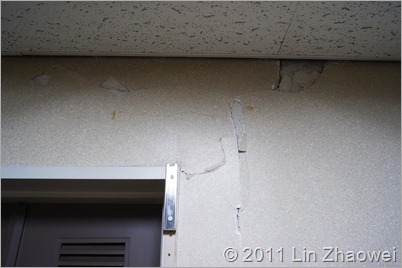
I also noticed that the building was not totally free of damage. Some of the walls had deep cracks stretching from the ceiling to midway down the way. But I believe the building was structurally sound enough. After all, Japan is known for its quake-proof technology. Unfortunately this time, it was the Tsunami that did most of the damage, to the coastal communities.

Had to charge my phone before I turned in for the night. I would need it to communicate and possibly write my story the following day. So while waiting for the phone to finish charging, which took quite a while, I took the chance to read the latest reports from NHK, CNN and BBC. Also discussed a bit about where we can possibly go the next day with the Nanfang Daily reporter and another Chinese reporter from Caijin.

Got a bit hungry by about 4am, and opened a packet of Ritz biscuits (from Narita) to eat. There were too many pieces in the pack, so I offered it to the few people sitting awake along the corridor, including the mother and son. Some took it with thanks, while others politely declined.

Sometime after 4.30am, the Blackberry was fully charged. I packed my bags and  squeezed into a small bit of available floor space in one of the rooms and turned in for the night. Unlike in Singapore when I often had insomnia, I drifted off to sleep almost immediately.

Next part here.

 
R0015437[5]

A small whiteboard outside a meeting room at the Sendai City Office. A special budgetary committee apparently was to meet here over two weeks, from Feb 28 to Mar 14. I think the earthquake would have disrupted their plans.


R0015436

Some cracks on the wall in the City Office building. Sendai City was generally resistant to the impact of the quake.


R0015444[5]

Some officials and refugees milling about in the main lobby.


R0015446[5]

You would have read much about how calmly the Japanese have dealt with the disaster so far. For me, this is one of the manifestations of that stoicism – they have continued separating the trash even in times like this.


R0015451[5]

A young man reading the latest news articles pasted on the walls of the corridors.


R0015456[5]

A man reading on his mobile phone in one of the rooms opened up for refugees. In the background, others were sitting about, using their computers or chatting with friends.


R0015458[5]

Some people prefer to sleep in the corridors, despite the cold. Perhaps because somewhat ironically, it is where one can get a little more privacy.


Part 1: It begun at Narita

Part 2: The long ride to Sendai

Part 4: A glimpse of the devastation

Part 5: The turning point, Ibaraki and the end